TheScientificTriangle
What about the environment and science
Interpreting Dreams using EEG- Yukiyasu Kamitani so far

We know there is a way to just not read our dreams but also see them live. Where is Yukiyasu Kamitani with his work on interpreting dreams right now? Read more about the experimental details from here.
Do you always want to know more about your dream meanings? If so, will this experiment excite you? It has been almost a year since the news spread about Japanese scientists developing an EEG (electroencephalogram) machine-led recording of your dreams. The machine cannot just record them but also store them and show them back to you whenever you want. When you can see the dreams, the interpretation of dreams becomes easier, and more clarity can be shed on the meaning of dreams that you saw last night.
More on interpreting dreams
Interpreting dreams was earlier a profession and is now a necessity. Most people understand that the dream world is a place that can be tapped for more information and details. With time, things are becoming more complicated, and dreams need to be interpreted more often. Many are convinced that it is our dreams that can serve as signals, give us potent warnings, and also help us out of situations.
Recently, almost a year ago, it was announced that a group of Japanese scientists had found a way to record your dreams and had also made it possible for people to watch them at a later stage.
What is the process by which the dream interpretation is being carried out?
Right now, it is nothing close to Inception or Dreamscape.
But we can say that it’s a start. A step forward!
Interpreting dreams using a normal EEG machine generates curiosity and arouses our interests.
Look into this article to understand a bit about the EEG machine, its ability to record your dreams, and its efficiency in helping you find out what your dream would mean.
What is an electroencephalogram?
An electroencephalogram (EEG) is a neural activity-interpreting machine. It measures the neural activity of the brain when small metal discs (electrodes) are stuck to the scalp of the individual.
EEG recordings are wavy lines and resemble an ECG in terms of the waves they create.
Experts can analyze these waves to find out the mental state of the individual through successive EEG recordings.
In scientific terms, EEG represents the biosignals. Scientifically, biosignals are nothing but the postsynaptic potentials of pyramidal neurons. These signals are generated by the allocortex and the neocortex.
When the leads are placed on the scalp, the microelectrodes gauge the ionic current using the non-extracellular space. The synchronous activity of different neurons with the vertical orientation of the scalp is considered in the EEG.
Understanding the interpretation of a normal EEG
Interpreting a normal EEG is not easy for a layman. However, if the EEG shows a frequency range of 1 and 30 Hz and an amplitude of 20 to 100 muV, then it means the EEG is normal.
The frequency and the amplitude can further be subdivided into the following wave patterns.
- Alpha waves
They originate when we are relaxed. Usually, the awakened state waves, or alpha waves, disappear sooner when we open our eyes.
- Beta waves
Normal waves when we are awake, and it does not get affected by open or closed eyes. Sedatives can usually influence these waves heavily. Benzodiazepines, chloral hydrates, and barbiturates cause increased beta waves.
- Theta waves
Sleep-related waves often appear when a person tends to fall asleep.
- Delta waves
Deep sleep waves are also a common appearance in young children.
Normal uses of an EEG machine
EEG can help detect abnormal waves caused by seizures and epilepsy. With the help of an EEG, the physician can understand the kind of epilepsy you suffer from. Even dementia-related issues can be handled well using an EEG machine.
EEG interpretations in the sleep/wakefulness cycle
EEG interpretations can tell you more about the sleep and wakefulness cycles.
- N1: Decreased alpha waves and rolling eye movements (4 to 7 Hz)
- N2: Spindle K-complexes (12 to 14 Hz/ 11 to 16 Hz)
- N3: increased amplitude and delta rhythm regularity (0.5 to 2 Hz)
Polysomnography is used to detect any kind of abnormality in the sleep-wakefulness cycle.
Working of the EEG machine
The workings of the EEG machine revolve around the differential amplification mechanism. Voltage differences between two particular points and among two electrodes are the basis of the workings of the EEG machine.
Ideally, there is a reference far electrode point and an active exploring electrode, and the difference between the two.
Stored EEG recordings and dream interpretations?
Dreams have always captured the fascination of different individuals. The REM (rapid eye movement) sleep pattern is closely related to the scientific studies around dreams. However, scientists have also noted that dreams don’t just appear in REM sleep but also in non-REM sleep.
Several neurophysiological studies have been undertaken and have been used for dream analysis and interpretation.
- These studies have shown that a lesion in the brainstem does not hinder with dream recall efficiency of a person during REM sleep generation.
- However, patients with a lesion in the focal forebrain did not have a problem with REM sleep but were not able to carry out the dream recall mechanism.
- The dichotomy between REM/non-REM sleep is now a concept of the past. What remains is another fact about the dream contents between REM and non-REM (NREM) sleep.
- Theta wave synchronization is a concept that seems to originate from neuronal changes that take place in the hippocampal (long-term memory storage and retrieval of memory) and neocortical structures (cognition, sensation, action, and consciousness) of the brain.
- Theta activity is shown to increase during the previous information retrieval phase. Intracranial EEG in patients has shown that theta wave generation has a primary role in the formation of dreams and memories.
What happens when there is increased theta wave production?
Anyone with increased theta wave production will show the following kinds of changes:
- Successful recall of different words and lists
- Optimal memory was associated with a clear coordination of spike timing in relation to theta oscillations.
- A higher level of theta hippocampal cortical phase and their coupling could help people successfully retrieve memory. When it happens in the Fz, F3, and F4 channels, it is known as the frontal midline theta.
Neurophysiological finings around dreaming
Several neurophysiological findings around dreaming involve (from Yukiyasu Kamitani’s experiment) and the following findings:
- Frontal lobe damage was not associated with dream loss.
- Parietal lesions showed complete dream loss or dream cessation instead.
- Dream loss was also evident in ventromesial frontal white matter damage.
- Global anoneria was associated with complete dream loss and cessation.
- Recurring nightmares were found to be a condition associated with temporal-limbic seizures. They are also associated with paroxysms
The current functioning of the EEG machine in interpreting dreams
A recent milestone was achieved in the way dreams can be interpreted by a human using a machine.
Most articles talk about successful dream interpretations by the Japanese team. It is far from the truth, but it is also not the truth that they haven’t headed anywhere about their dreams
Breakthrough organization
Yukiyasu Kamitani of the ATR Computational Neuroscience Laboratories in Kyoto, Japan.
Number of people scanned
Scanning was done on 3 people.
Type of scanning used
Electroencephalogram (commonly known as EEG)
Findings shared at
Society for Neuroscience in New Orleans, Louisiana, in October 2012.
Test procedure
A polysomnogram (Gold Standard) was used for analysis.
Step 1: The patients were put to sleep after attaching the electrodes in the right place.
Second Step: The patients were woken up each time the sleep onset brain pattern was detected.
Step 3: They were asked to briefly describe the objects seen in dreams. Further, they were allowed to go back to sleep.
Fourth Step: Every three hours, they repeated it 7–10 times, and it was also done on different days for different participants.
Every hour, the participants were woken up ten times.
Step 5: Participants informed me they dreamt 6-7 times in each hour.
A total of 200 dream reports were generated in this way by the research team.
Interpretation of dreams
Dream interpretations were undertaken after the reports were collected together.
Read more about the dream interpretation experiment here
What did they find out?
Here is how they reached their conclusions about dream interpretations.
- They found out that most of the dreams centered around ordinary objects.
- But some dreams center around specific and special scenarios.
- Each participant gave out a clue about what they dreamed about.
- Next, based on the words that were recited by the participants, the researchers picked up 20 different categories.
- Words like female, male, computer, car, and other such words were what the participants frequented, and the categories revolved around these words.
- The next photos of each of these objects were chosen by the researchers.
The explanatory part of Yukiyasu Kamitani’s so far- on his way to interpreting dreams
- These were shown to the participants while their brains were scanned to understand the wave pattern generated during their viewing of the object.
- The brain activity patterns were matched with the already pre-recorded sleep patterns recorded by the participants before waking them up from sleep.
- V1, V2, and V3 data from the brain were analyzed.
- Early stages of visual processing and basic features of different visual scenes were analyzed, like contrast and edge orientations.
- They also looked at other higher-order visual functions of the brain, like object recognition.
- After doing all of it, in 2008, Kamitani and his colleagues reported that they were capable of deciphering and reconstructing earliest-stage visual processing images through the right processing of images.
- In recent times, they have found out different activities in the higher-order visual regions and stated that even object recognition can also be predicted.
According to Kamitani, their model could work with 70–80% accuracy in determining if the subject in question was dreaming in the last 9 seconds before waking the subject from the dream. Also, they can predict the category of content that the subject was dreaming about through their model.
Current deep image reconstruction is ongoing in the Kamitani Lab. Details are being shared on YouTube, and the last update shared was in December 2023
Interpreting dreams and how they work?
When we dream, which parts are involved in making our dreams?
The dream mode
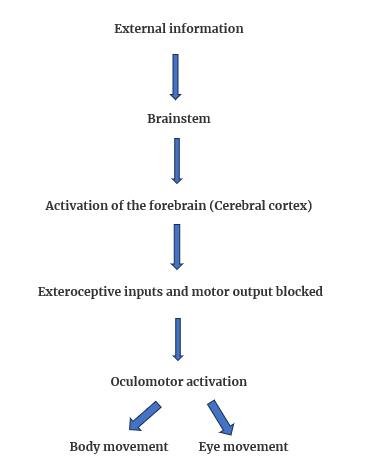
Involvement of different brain centers when interpreting dreams?
| Brain region | Functions |
| Frontoparietal cortex | Future planning, internal state processing, taking decisions, memory (prospective and the current working memory) |
| Ventrolateral prefrontal cortex | Emotions around self-consciousness, regulating emotions, planning actions, and decision making |
| Dorsolateral prefrontal cortex | Meta-cognitive evaluations, higher consciousness levels, working memory building, decision making, and selective attention |
| Parietal cortex | Choosing information that you want to process, attentiveness, neural integration, semantic understanding, language processing, self-awareness, episodic, and working memory |
| Temporo-parietal cortex | Memory of words and communication, integration of information, self-consciousness, and body imagery |
| Precuneus | Reflective self-awareness, self-imagery, episodic memories, and visuospatial imagery |
| Cuneus | Reflective self-awareness, visual perceptions, processing, and association of visions |
| Occipito-temporal cortex | Visual & body-part perception, processing, decision making, prospective and working memory formation |
FAQs (Frequently Asked Questions)
Recording and Interpreting Dreams by Electroencephalography
How much time during the night does an individual spend dreaming?
An individual would spend anywhere up to 2 hours dreaming during sleep. Usually, now we know that it’s not just REM sleep where we dream; we can also dream in NREM sleep.
How long can a dream last?
According to neurocognitive physiology, a dream can last anywhere from 5 to 20 minutes at a stretch. The beginnings of a dream are usually something no one can recall correctly, no matter how accurately we measure our memories, but the ends are what we almost always remember very well.
What kind of time related concept do we experience when we are trying to interpret dreams?
We usually feel the time is longer than it actually is, and, in our dreams, we often experience what is commonly known as time dilation.
Conclusion
Neither Interstellar nor Reminiscence are still realities, but such experiments might find a way of interpreting dreams. We might someday actually dive into understanding the meaning of our dreams. The interpretation of dreams is essential, as they could be the next gateway to our future.
If you have anything to share about dreams, please follow us here and write to us.
Rea more of TST blogs here
 TheScientificTriangle
You must be logged in to post a comment.