TheScientificTriangle
What about the environment and science
10 AI Applications in Healthcare Marking Its New Era
AI applications in healthcare and medicine are a fairly evolving concept but it can spurt the healthcare industry towards a new direction of better patient care through effective diagnosis, treatment, and reduction in the time & cost of drug development.
What’s possible with AI is no longer limited to sci-fi novels & movies but we are sensing its presence already in real-life. Aren’t we witnessing the presence of AI in the IT and the Telecom sector already? Similarly, the healthcare sector is no longer behind in the race to incorporate AI for enhancing patient care.
In 2020 March, when WHO assigned the pandemic status to Covid-19, the health management system of the world was not only unprepared for it, it even stood on the brink of collapse in some third-world nations. It was then that disinfection robots, CDC’s AI-powered bots screening for Covid-19 infections, autonomous PPE deliveries, and AI-driven thermal scanners came into the picture to save the day.
Artificial intelligence in the healthcare market expanded at a rate of 167.1% from 2019 to 2021. By 2028, Vantage Market Research estimates that the global AI healthcare market will grow at a CAGR (compound annual growth rate) of 46.1%. Further, it is estimated to reach a valuation of $95.65 billion from the current value of $6.6 billion.
Therefore, let’s dive into the article to know about the ten AI applications in healthcare and gain a grasp of how the healthcare sector will undergo a paradigm shift over the coming years.
What is artificial intelligence in medicine?
According to the book Artificial Intelligence in Medicine, “Artificial Intelligence itself can be defined as the technology that enables computers to perform more intelligently.” “Thereby, AIM (Artificial Intelligence in Medicine) refers to the Artificial Intelligence which is trained at performing medical applications.”
Computer vision, machine learning (ML), and deep learning (DL) are the sub-groups of AI. ML utilizes certain traits to identify patterns for analyzing specific situations. DL consists of algorithms to create an artificial neural network (ANN) to learn and make decisions analogous to human intelligence. Computer vision helps a computer gain more understanding from images and videos.
According to a 2018 report by Forbes, AI would most prominently be applicable in image analysis, robotic surgery, virtual assistants, and providing support for clinical decisions. Whereas, a 2019 report from McKinsey also highlighted other areas of application such as cognitive devices, targeted & personalized medicines, electroceuticals, and robotic-assisted surgery.
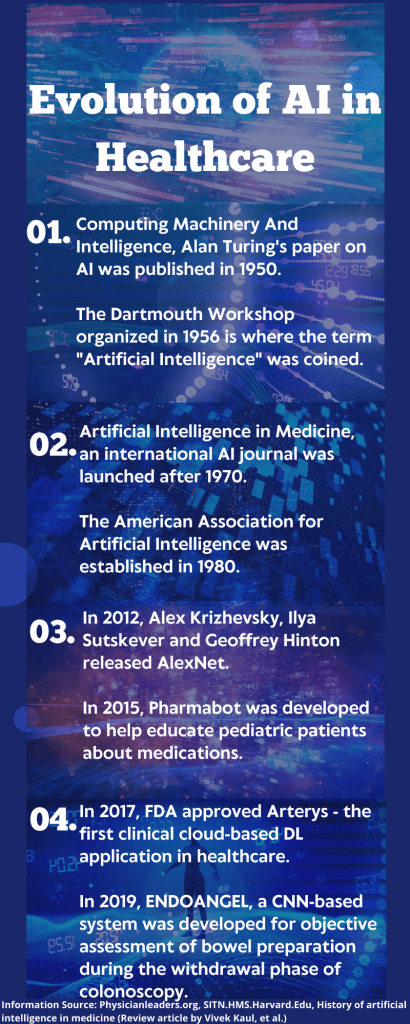
A brief history of AI’s evolution in healthcare
The below infographic explains the transition and evolution of AI in healthcare.
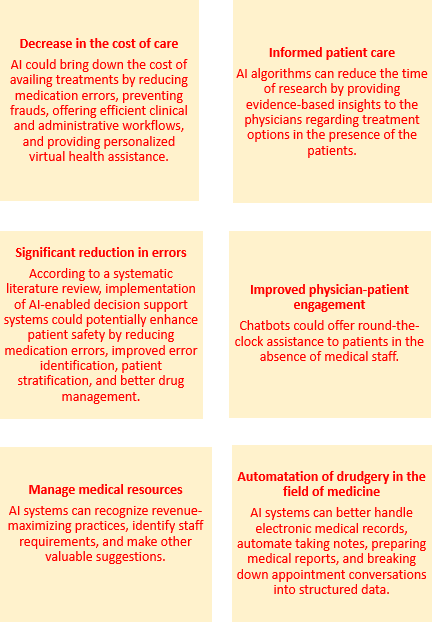
Advantages of AI in medicine
The integration of artificial intelligence into medicine and healthcare is beneficial in more than one way, and they are:
10 revolutionary AI applications in healthcare
Check out these ten implementations of AI in healthcare and medicine.
1. Employing genome sequencing to implement precision medicine
Researchers are estimating that by the next decade a significant part of the world population would have access to their entire genome sequencing. An organism’s whole genome sequencing comprises 100 to 150 GB of data that can have varied utilities.
According to CDC, sequencing refers to the determination of the order of bases and whole genome sequencing (WGS) refers to determining the order of bases of an organism in a single process.
Deep Genomics is a Canada-based health tech company pioneering new treatment methods with AI.
- They are trying to find a correlation between the massive amounts of genetic datasets and EMR to identify disease markers.
- This would eventually help them to recognize therapeutic agents for targeted drug delivery, lead optimization, toxicity assessment, and effective trial design. Thus, WGS and AI can help treat genetic diseases by employing precision medicine.
2. Medical visualization for performing surgical procedures

The application of deep learning and artificial neural networks can aid in improving computer vision algorithms. This could play a pivotal role in enhancing the precision of surgical procedures.
- AI-enabled robotic surgeries can hasten the time required to perform surgeries. It can also minimize many invasive procedures. Johns Hopkins University’s STAR (smart tissue autonomous robot) performed laparoscopic surgery on pig’s soft tissue independently sans a surgeon’s aid.
- Besides this, surgeons employed AI-assisted robots to suture narrow blood vessels of 0.03 – 0.08 mm at Netherland’s Maastricht University Medical Center.
3. Prompt diagnosis of diseases with AI

Viz.ai is an Intelligent Care Coordination Platform that employs AI-powered solutions to save patient’s life by promoting coordination between multidisciplinary teams and frontline medical professionals.
- The platform’s mission is to make use of artificial intelligence in healthcare to increase people’s access to immediate treatment and prevent delays. It is accessible through smartphones, personal computers, and tablets.
- Viz.ai facilitates mobile image viewing of CT, CTA, MRI, X-Ray, EKG, USG, etc.
- Besides this, it can help physicians receive real-time patient information, promote bi-directional electronic health records integration, and alert multi-disciplinary teams for immediate action.
4. Virtual Nursing Assistants

As per ReportLinker, virtual nursing assistants can save the healthcare industry $20 billion in a year and is thereby regarded as one of the most brilliant AI applications in healthcare.
- AI-powered virtual nursing assistants can track a patient’s vitals, alert the clinicians in case of emergencies, and interact with the patients in real-time.
- They can also guide patients throughout their treatment course.
- Care Angel is an artificially intelligent nurse that can boost health awareness. It can furnish constant healthcare management inexpensively to drive better clinical outcomes. It also offers real-time notifications and unique insights for effective and timely clinical interventions.
5. Enhancing the efficiency of clinical trials

Clinical trials can sometimes be complete in six to seven years. As per a report by Grand View Research, the market size value of the global AI-based clinical trials solution provider was $1.3 billion in 2021 and is expected to grow up to 22% by 2030.
- The use of AI in healthcare and clinical trials can significantly reduce the time taken to achieve patient outcomes by intelligently furnishing medical codes in a shorter time.
- Two CROs, Biostata and Prosciento took the help of IBM Watson Health to employ AI for searching the correct MedDRA codes.
- AI reducing the searches by 70% – 80% for medical coders for the number of verbatim that needed two or more searches compared to the searches performed without employing AI.
6. Better cancer prognosis with AI

As per a study by Johns Hopkins, about one-third of deaths happen as a consequence of misdiagnosis or delayed diagnosis. Wrong prognosis is the most prominent cause of serious medical errors. In the U.S., about 12 million people face diagnostic errors each year and among them, about 40,000 to 80,000 people die.
- PathAI, an AI-enabled tech company that is working towards enhancing patient care by assisting pathologists in making improved cancer diagnoses.
- It’s working in collaboration with biopharma, laboratories, and clinicians to develop better individualized medical treatment. Thus, it has entered into strategic partnerships with Roche, BMS, and Bill & Melinda Gates Foundation for further expansion.
7. Development of biopharmaceuticals

The development of novel drugs is another incredible example of AI implementation in healthcare. The involvement of artificial intelligence in drug development can reduce the time taken to identify new therapeutic agents and the development timelines. Further, it optimizes R&D economics and increases the chances of success.
- BioXcel Therapeutics is a clinical-stage biopharmaceutical company that is using an innovative approach to develop neuroscience and immune-oncology drugs with the aid of AI techniques.
8. Better management of patients in hospitals

Google’s DeepMind Health is an AI software that can track and collect patient symptoms and help clinicians make a quick prognosis to initiate a faster treatment plan for the patients.
- This way DeepMind can shorten the time lapse occurring between diagnostic tests and the onset of treatment to improve the chances of survival.
- This platform is capable of accelerating the process of diagnosis of ailments by combining its humongous dataset to identify the symptoms faster.
9. Targeted drug delivery using DL

BenevolentAI is pioneering drug discovery and development by combining pharmaceutical science with deep learning and artificial intelligence.
- The company is collaborating with big pharma to license therapeutic agents designed with better target selection through deep learning’s help.
- They aim to unravel complex diseases and provide effective therapies to patients as required by them.
10. AI-based personal health tracking app

Another brilliant use of artificial intelligence in healthcare involves better management of chronic conditions for diabetic, cardiac, and hypertensive patients with AI-enabled digital tools.
- One Drop is a one-stop whole-person solution to manage weight, hypertension, type 1 & 2 diabetes, and cholesterol.
- The One Drop Premium app offers health coaching, tracks essential health data, and also establishes health trends.
- It syncs with other popular fitness apps and devices too.
- The 2022 MedTech Breakthrough Awards Program named One Drop’s app as the Best Personal Health App.
Prominent business groups working on AI healthcare projects
Here are the most prominent business groups that are vigorously working towards the incorporation and application of AI in healthcare.

What are the success factors of AI applications in healthcare?
In a recent study Adam Bohr and Kaveh Memarzadeh the factors that are supporting the application of AI in healthcare have been discussed:
- Accurate assessment of disease condition.
An MIT-based lab researched extensively to create a sequence modeling for earlier detection of depression through speech pattern recognition.
- Better management of complications associated with some diseases.
Implementation of machine learning techniques could predict whether patients having type 2 diabetes are susceptible to developing further complications such as nephropathy, neuropathy, retinopathy, or early cardiovascular diseases.
- Providing improved assistance for patient care.
Virtual health assistants could remind patients to take their medicines on time every day.
- Providing a boost to extensive medical research
Predictive Oncology has declared its decision to launch an AI platform for achieving new diagnostics and producing vaccines with the help of 12,000 computer simulations per machine.
New challenges to mitigate with AI’s implementation in healthcare
According to reports from Deloitte, Brookings, and SITN the risks that are going to arise with the full-scale application of AI in healthcare and their possible solutions are discussed below.
1. Addressing patient privacy challenges
The use of artificial intelligence in healthcare involves the generation, collection, and reliance on a huge amount of patient data, clinical trial data, and pharmaceutical data. The following solutions can mitigate the risks arising out of data storage and sharing across organizations.
- De-identifying the data before sharing it across organizations is an effective way to ensure patient privacy and data safety.
- Setting strict policies and regulations across organizations to ensure proper sharing of patient data.
- Direct investment in the generation of high-quality datasets is another solution. In this regard, the United States’ All of Us initiative and the U.K.’s BioBank was launched.
- Also, taking industry-level measures to safeguard against hackers and unauthorized access.
2. Quality oversight gap mitigation
The Food and Drug Administration (FDA) reviews the commercially marketed AI products created for the healthcare industry. However, certain AI systems don’t fall under the FDA’s purview such as the ones that don’t typically cater to the field of medicine or are developed in-house by hospitals.
- In such scenarios, the American College of Radiology, the American Medical Association, EFPIA, other regulatory agencies of other nations, and hospitals should step in to evaluate the effectiveness of such AI health systems.
3. Resolving concerns regarding the acceptance of AI-powered trials
When it comes to approving clinical trials, the FDA sticks to stringent approval criteria. This requires full transparency around the data collection methods, and the scientific methods used to evaluate the results to reach conclusions. However, when it comes to relying on algorithm-generated conclusions regarding trials, then a lot is at stake. This is because many algorithms utilize complex mathematics that is not always easy to decipher and decode, thereby, being referred to as a ‘black box.’ Also, entrepreneurs, researchers, and organizations might not be willing to reveal their proprietary methods entirely.
- Therefore, one way to mitigate this problem would be by updating the patent law where an algorithm is allowed to be patentable irrespective of whether it is a part of a physical machine or not.
4. Mitigating the knowledge gap between professionals and patients
With the implementation of AI in healthcare, a demand arises in the necessity to educate computationalists, healthcare professionals, and also patients. This is because the FDA and the other pharmaceutical regulatory agencies haven’t provided universal algorithm approval guidelines. Also, programmers creating the algorithms lack the knowledge of medical practitioners while clinicians and patients are not tech-savvy.
- This problem can be overcome by conducting knowledge transfer sessions to help computationalists and mathematicians comprehend the field of medicine and patient care while physicians and patients need to understand how to employ the algorithms in the best possible way.
In Conclusion
The use of AI in healthcare is still in its nascent phases and needs some time before clinicians, researchers, and patients fully get the hang of it. Artificial Intelligence is not yet fully ready to replace clinical training and judgement. It must only be used to improve the quality of patient care and to boost the productivity of healthcare professionals.
At this point, it is essential to ensure that providers and physicians are only incorporating AI in regular workflows. Additionally, AI is also accelerating the speed of pharmaceutical treatment development.
However, at this stage, health systems, organizations, and medical professionals should not begin depending too much on AI technologies so that they lose their clinical expertise. At the same time, AI recommendations must always be evaluated and monitored by clinicians before implementing them on patients.
FAQs
1. How AI is used in healthcare?
Nowadays, there are multiple ways in which artificial intelligence is being used in the healthcare industry. To know more about it, read the above article.
2. What are the benefits of AI in healthcare?
The use of AI in healthcare offers numerous benefits. Most importantly, it is useful in implementing personalized patient care. Other than that, it is playing a key role in accelerating pharmaceutical research & development and boosting the productivity of the medical staff.
3. What is the future of AI in healthcare?
In the future, AI implementation in healthcare could range from chatting with patients, conducting medical record reviews, preparing analytical reports, reading and deciphering radiology images, making treatment plans, and reminding patients to take their medications on time.
4. Who is leading AI in healthcare?
Remedy Health is a San Francisco-based company which is the best AI healthcare company in the world in 2022.
Also Read: 12 Groundbreaking Recent Medical Discoveries
 TheScientificTriangle
Pingback: Why Do Blind People Wear Sunglasses – An Expert Take